How to Choose the Right Under-Sink Reverse Osmosis System for Your Family
/
And Why I Chose the Waterdrop G2P600 for My Family of 5
If you're shopping for an under-sink reverse osmosis system, one of the first things you'll notice is how many different sizes there are: 400 GPD, 500 GPD, 600 GPD, 800 GPD, even 1,200 GPD.
So how much do you actually need?
The answer isn't simply "buy the biggest one." The right RO system depends on how many people are in your household, how much filtered water you use, and how quickly you want water available at the faucet.
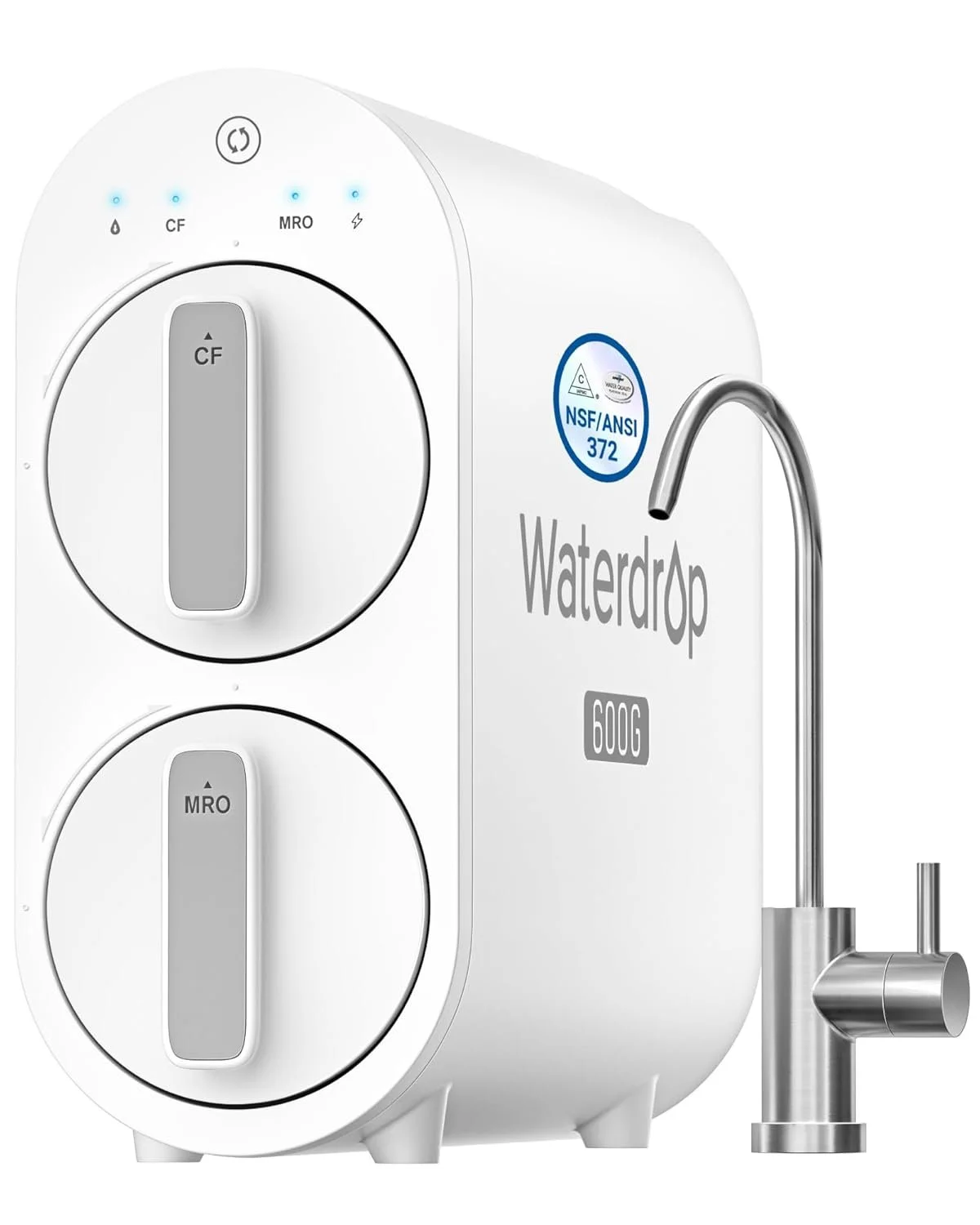
For my family of five, I chose the Waterdrop G2P600 600 GPD Tankless Reverse Osmosis System.
See the Waterdrop G2P600 I chose for my family on Amazon
Disclosure: This post contains an affiliate link. If you make a purchase through the link, I may earn a commission at no additional cost to you.
The RO System I Chose for Our Family of Five
The Waterdrop G2P600 is a compact, tankless under-sink reverse osmosis system.
The model I chose is the Waterdrop G2P600.
It is rated for 600 gallons per day (GPD) and uses a tankless design, so there isn't a large traditional RO storage tank taking up most of the cabinet underneath the sink. Waterdrop specifies a flow rate of approximately 0.42 gallons per minute, or roughly an 8-ounce cup in eight seconds. The manufacturer also lists a 2:1 pure-water-to-drain-water ratio.
For a household of five, 600 GPD gives us plenty of capacity without jumping all the way to one of the larger—and usually more expensive—800- or 1,200-GPD systems.
Check the current price and details on Amazon
First: Don't Let the "GPD" Number Confuse You
GPD stands for gallons per day.
A 600-GPD RO system does not mean your family is expected to drink 600 gallons of water every day.
Think of the GPD rating more as the system's production capacity under specified operating conditions. In a tankless system, a higher-capacity membrane and pump can also translate into more convenient dispensing and faster recovery when several people are using filtered water throughout the day.
A family of five might use filtered RO water for:
Drinking water
Coffee and tea
Cooking
Filling reusable water bottles
Making ice
Pet water
Baby formula
Smoothies
Soups and pasta
Washing fruits and vegetables
Once you start using filtered water for more than simply filling a drinking glass, household demand can add up surprisingly quickly.
A Simple RO Size Guide by Family Size
This isn't a hard rule, but it's a useful starting point when comparing tankless systems.
A Good Household Starting Range:
1–2 people = 400–500 GPD for light to normal drinking and cooking.
3–4 people = 500–600 GPD for regular household use.
5–6 people = 600–800 GPD for frequent drinking, cooking and bottle filling.
7+ people = 800–1,200 GPD for large or high-use households.
The important word here is starting.
Two families with five people can have completely different water habits.
Step 1: Count People—Then Count How You Actually Use Water
Family size is helpful, but water use matters even more.
For example, imagine two five-person households:
Family A
Everyone drinks tap water, but filtered water is mainly used for drinking glasses and an occasional pot of coffee.
Their demand is relatively modest.
Family B
Five people fill insulated bottles every morning, make coffee, cook with RO water, refill bottles after school or workouts, make ice and give filtered water to their pets.
Their system gets much more use.
Both families have five people, but Family B will appreciate higher flow and capacity much more.
That's why I wouldn't choose an RO unit based on household size alone.
Step 2: Think About Peak Usage
Average daily consumption isn't the only thing that matters.
Think about 7:00 in the morning.
One person is filling a 32-ounce water bottle.
Someone else needs water for coffee.
Another person is filling a school bottle.
Someone is making breakfast.
That's when a system that seemed perfectly adequate on paper can suddenly feel painfully slow.
For a larger household, I would rather have some extra capacity than stand at the sink waiting every morning.
That is one reason the 600-GPD range made sense for our family of five.
Step 3: Check the Faucet Flow Rate
Don't look at GPD alone.
Look for the manufacturer's gallons-per-minute (GPM) specification whenever it's available.
Waterdrop lists the G2P600 at approximately 0.42 GPM, saying it can fill an 8-ounce cup in about eight seconds.
That's a much more relatable measurement when you're standing at the kitchen sink.
If your family regularly fills large bottles, coffee makers and cooking pots, faucet speed can make a meaningful difference in everyday convenience.
Step 4: Look at the Pure-to-Drain Ratio
Reverse osmosis filtration produces purified water and also sends some water to the drain during the filtration process.
That's why you'll see specifications such as:
1:1
2:1
3:1
A 2:1 pure-to-drain ratio, for example, means approximately two parts purified water are produced for every one part discharged.
Waterdrop lists the G2P600 at a 2:1 ratio.
When comparing two otherwise similar RO units, I would generally give the advantage to the system with better water efficiency.
Step 5: Tankless or Traditional Tank?
A tankless RO design can free up valuable storage space underneath the kitchen sink.
Traditional RO systems usually store purified water in a pressurized tank.
Tankless systems filter water as you need it and use an internal pump to provide faster production.
For me, the tankless design is particularly appealing because under-sink cabinet space is valuable.
No giant storage tank means more room for the things that normally live underneath a kitchen sink.
Keep in mind that powered tankless systems typically require access to an electrical outlet under the sink, so check your cabinet before ordering.
Step 6: Measure Before You Buy
This is an easy step to skip.
Before ordering any under-sink RO system:
Measure the height, width and depth of the available cabinet space.
Look at your garbage disposal and drain plumbing.
Check where the water supply line enters the cabinet.
Verify that you have an appropriate electrical outlet if the system requires power.
Make sure there's room to access and replace the filters later.
Determine where the RO faucet will be installed.
Don't measure only enough space to squeeze the machine into the cabinet.
Leave yourself enough room to service it.
Step 7: Look at Replacement Filters Before Buying the Machine
The purchase price isn't the full cost of an RO system.
Before choosing any model, check:
How many filters it uses
Replacement intervals
Current replacement-filter prices
Whether filters are widely available
How easy they are to change
Waterdrop's G2P600 uses replaceable filtration cartridges, so replacement filters should be considered part of the long-term ownership cost rather than an afterthought. Waterdrop currently sells a dedicated G2P600 replacement-filter bundle.
A bargain RO machine isn't necessarily a bargain if proprietary filters become expensive or difficult to find.
Step 8: Consider What's Actually in Your Water
Choosing the right size is only half of the decision.
You also need the right type of filtration.
If you're on municipal water, look at your local annual water-quality report.
If you're using well water, professional water testing is especially important.
Depending on your water, you may want to pay particular attention to:
Total dissolved solids (TDS)
Lead
Arsenic
Nitrates
Fluoride
Hardness
Iron
Manganese
PFAS
Microbiological contamination
Don't assume every RO system has independently certified reduction claims for every contaminant.
Check the specific model's certification documentation when a particular contaminant is important to you.
Why I Chose 600 GPD for a Family of Five
For our household, 600 GPD felt like the sweet spot.
I wanted enough capacity that five people could use filtered water throughout the day without choosing a huge, premium-priced system simply because it had the biggest number on the box.
The Waterdrop G2P600 gives me:
600-GPD rated capacity
Tankless under-sink design
Approximately 0.42-GPM water flow
2:1 pure-to-drain ratio
A compact two-filter design
Waterdrop also describes the G2P600 as using two composite filters for its filtration process.
For my family's size and expected use, that combination made more sense to me than paying more simply to move up to the highest-capacity model available.
This is the Waterdrop G2P600 I chose for my family of five
When I Would Choose a Smaller System
If I lived alone or with one other person and mostly wanted RO water for drinking, I probably wouldn't consider 600 GPD essential.
A lower-capacity tankless system could be perfectly adequate and may cost less.
I'd especially consider stepping down if:
Only one or two people use the system
You rarely cook with filtered water
You don't fill multiple large bottles
Faucet speed isn't especially important
Saving money upfront is the priority
When I Would Choose an 800- or 1,200-GPD System
I'd consider moving above 600 GPD if I had a very large household or unusually high demand.
For example:
Seven or more people
Several large insulated bottles being filled every day
Heavy cooking with RO water
Frequent entertaining
A particularly high demand for filtered water at the same time
A desire for the fastest available faucet flow
In those situations, paying more for additional capacity may be worthwhile.
For an average five-person household, however, I would compare the additional cost carefully before automatically jumping to the biggest unit.
My Quick Rule for Choosing an Under-Sink RO System
When shopping, I would prioritize these factors in this order:
1. Your water-quality needs
Make sure the system addresses the contaminants you're concerned about.
2. Certification
Look at what the specific model is actually independently certified to do.
3. Household demand
Consider both the number of people and how much RO water you'll use.
4. Faucet flow
Especially important for families filling several bottles.
5. Water efficiency
Compare pure-to-drain ratios.
6. Replacement-filter costs
You'll be buying them for years.
7. Cabinet space
Measure first.
8. Extra features
Smart faucets, remineralization and other features can be useful, but don't let them distract you from filtration performance and long-term cost.
Bottom Line
You don't need the biggest reverse osmosis system on the market simply because you have a family.
You need one that fits your family's actual habits.
For one or two people, a 400- to 500-GPD tankless system may provide all the capacity you want.
For three or four people, I would start comparing models around 500 to 600 GPD.
For a family of five or six with regular drinking and cooking use, 600 to 800 GPD is a sensible range to investigate.
And for our family of five, I chose the 600-GPD Waterdrop G2P600.
It provides the capacity I was looking for without paying for a much larger system that we may never need.
The Model I Chose
Waterdrop G2P600 600 GPD Tankless Reverse Osmosis System
Affiliate disclosure: I may earn a commission from qualifying purchases made through links in this article, at no additional cost to you.
Editor's note: Product specifications can change. Confirm current specifications, certifications, replacement-filter requirements and installation requirements with the manufacturer or retailer before purchasing.
Double-click to edit...